
Short answer: match the deterrent to the surface. Use spikes on narrow ledges and sills, and netting to close a balcony or a recess. Use wire on long flat edges and a guard under solar panels. Scare devices are a cheap extra, not a full fix. For a ranked shortlist of the products we list, see our pest control product ranking.
A pigeon has found your window ledge. It has told its friends, and the ledge now hosts a small committee every morning. You do not need to win an argument with a bird. You only need to make one spot less comfortable than the roof next door.
This guide matches each type of pigeon deterrent to the surface you want to protect, then sorts them by budget. The goal is simple: stop pigeons landing and nesting, without harming them, and without breaking a rule.
First, the ground rules
Pigeons are wild birds, and the rules protect them. Deterrents are meant to keep birds away, not to trap, injure or kill them.
- EU readers: rules on wild birds differ from country to country. Check with your local authority before you do anything beyond blocking a surface.
- UK difference (England): feral pigeons can only be controlled under the terms of a licence. Natural England’s general licence GL42 “is valid from 1 January 2026 to 31 December 2026” and applies to England only. Also, “only an authorised person can use this licence”: the land owner or occupier, or someone they authorise. It covers action to prevent serious damage to livestock foodstuffs and to crops, fruit and vegetables. GL42 does not cover a pigeon on your balcony rail (GOV.UK / Natural England, GL42). Natural England publishes other general licences too, so check its general licences for wildlife management before you act.
- GL42 also says that disturbing a Schedule 1 species while it is nesting, intentionally or recklessly, is an offence. If you are not sure which bird is nesting, leave the nest alone and ask your local authority.
The safest rule: install deterrents before birds start nesting, and never block birds inside a space where they already have eggs or chicks.
Pigeon deterrents by surface
| Surface | Best fit | Why | Watch out for |
|---|---|---|---|
| Window ledge, sill | Spikes | No flat spot left to land on | Measure the depth: the strip must cover the full width |
| Balcony (closed in) | Netting | Closes the whole space, birds cannot get in | Landlord or building permission, look of the facade |
| Balcony rail | Wire or spikes | Rail stays usable for you, not for perching | Keep wire taut so birds cannot sit on it |
| Roof ridge, long parapet | Wire or spikes | Covers long runs on a clean line | Roof work is a job for a pro with fall protection |
| Solar panels | Mesh guard around the panel edge | Stops nesting in the gap under the panel | Never drill the panels; ask the installer first |
| Signs, beams, recesses | Netting | Closes a box shape completely | Check that no bird is inside before you close it |
| Any surface, short term | Scare devices | Cheap, no fixing | Pigeons get used to them |
Window ledges and sills: spikes do the talking
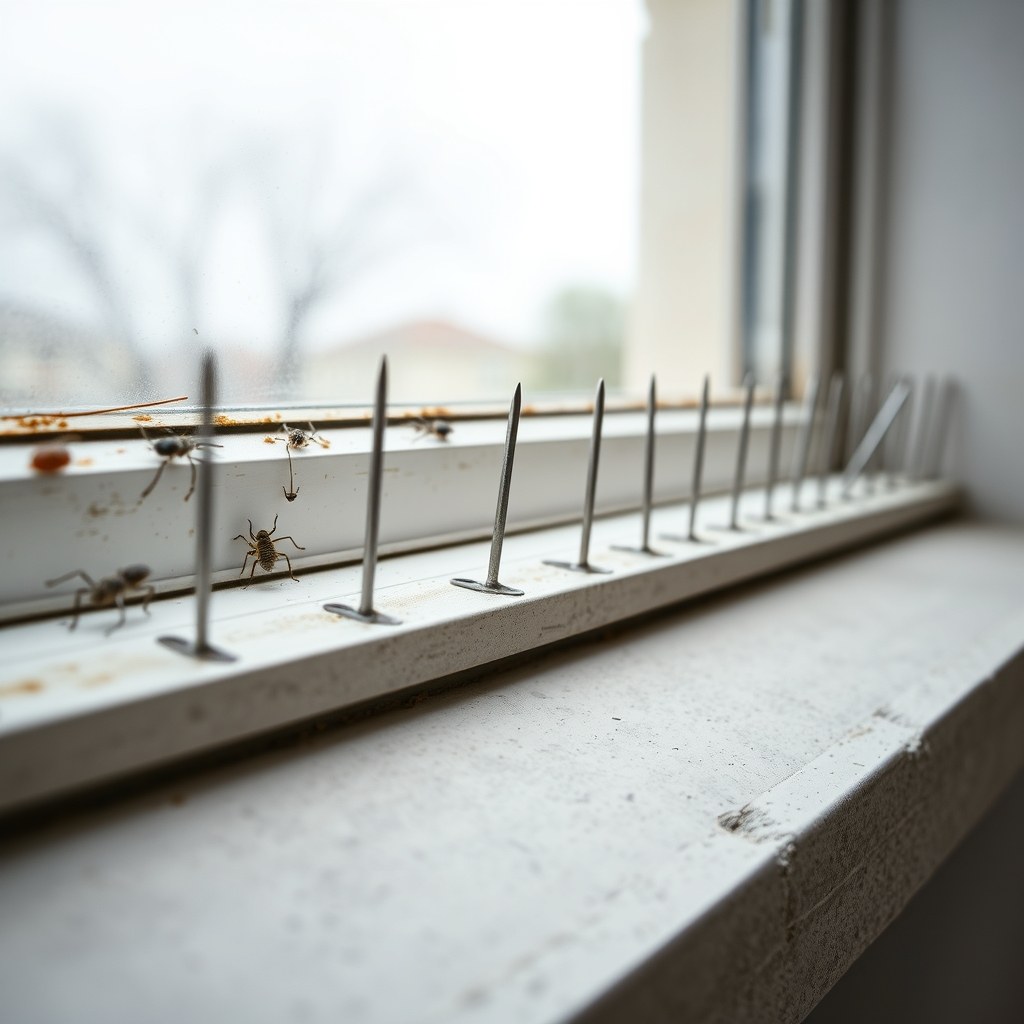
Spikes are the classic answer for a narrow ledge. The bird looks for a flat place to land, finds a row of plastic or steel points, and moves on. The spikes take the parking space away.
What to check before you buy:
- Measure the ledge length and depth.
- Choose a strip wide enough to cover the depth. A narrow strip on a deep ledge leaves a landing lane beside it.
- Clean the surface first, then fix the strip with screws or the method the maker gives.
- Run the spikes right to the ends of the ledge. Any bare end is a free perch.
Product from our list: the Windhager Pigeon Deterrent Spikes Starter Set, 36 Spikes costs €17.99 at the retailer we checked. It scores 7/10 in our ranking. According to the retailer’s product page, it is a set of plastic plug-in modules with 36 spikes about 11 cm tall. It covers up to 1 m of ledge, with screws and dowels in the box. It is sold for outdoor use on ledges and sills. For a longer ledge, add extension sets.
Balconies: netting closes the deal
On a balcony, spikes only protect the rail. If pigeons nest in a corner or behind a plant pot, netting is the one product that closes the whole space.
- Ask first. In a rented flat or a shared building, nets change the facade. Get written permission from the landlord or building management.
- Measure each open side, from the ceiling of the balcony to the rail or floor.
- Fix the net on a frame or on wires, tight, with no gap at the corners.
- Check that no bird is on the balcony, and no nest is in use, before you close the last side.
Pick a net colour close to the wall, so the facade changes as little as possible.
Roofs and long edges: wire and spikes
On a roof ridge or a long parapet, the job is about length. Spike strips work, and so does a tensioned wire system, where thin wires on small posts stop birds from settling on the edge.
Safety first: working on a roof means a real fall risk. The HSE names the main causes of death and injury in roof work. They are falls from roof edges or openings, and through fragile roofs and rooflights (HSE, Roof work). Do not climb onto a roof yourself to fit deterrents. This is the point where you hire a professional with the right access equipment.
Solar panels: guard the gap underneath
Pigeons like the sheltered gap under a solar panel. The usual fix is a mesh guard, clipped around the edge of the panel array so birds cannot get underneath.
- Do not drill into the panels or the frame.
- Ask your installer which clips or fixings they accept, so your warranty terms stay clear.
- Panels on a roof are roof work. See the warning above.
Gel: handle with care
Repellent gels make a surface feel unpleasant to land on. They need no drilling, which helps on a ledge you cannot drill. Follow the label for where to apply them and how often to renew them.
If the gel’s label carries a biocide authorisation or approval number, it is a biocide. The HSE says only authorised or approved biocides can carry one. The HSE is clear on the next step: “Before using a biocidal product, you must make sure you read and understand the label.” Keep it in its original container, sealed, and “out of reach of children and pets”. (HSE, Using biocides) For disposal, follow the label, or ask your local authority’s waste department.
Scare devices: the cheap bluff
Fake owls, reflective tape, spinning discs and similar devices try to make pigeons nervous. They cost little and need no fixing. The weak point is habit: a plastic owl that never moves can end up as a nice place to sit next to. Use scarers as a short-term extra, move them often, and pair them with a physical barrier.
Pigeon deterrents by budget
We do not quote prices for products outside our list, because they vary too much between countries and shops. The table below ranks the options by relative cost, from cheapest to most expensive.
| Budget | Options | Good for |
|---|---|---|
| Low | Scare devices, a short spike strip | A single ledge, a first try |
| Low to medium | Spike strips over several metres, gel | Several sills, ledges you cannot drill |
| Medium | Balcony netting kit, wire system you fit yourself | A whole balcony, a long rail |
| High | Professional netting or wire, solar panel guards fitted by a pro | Roofs, panels, large facades |
A single window ledge up to 1 m long costs €17.99 with the Windhager set above, at the retailer we checked. Beyond that, the cost grows with length and with how high you need to climb.
Which pigeon deterrent should you choose?
- One or two window ledges: spikes. Cheap, quick, and they work as long as they cover the full depth.
- A balcony where birds nest: netting, with permission from the landlord.
- A long rail or ridge: wire or spikes; call a pro for anything on the roof.
- Solar panels: a mesh guard, fitted with the installer’s agreement.
- A quick test before you invest: a scare device, moved every few days.
Whatever you choose, clean the surface first and fit the barrier before the nesting starts. Our ranking of pest control products lists the pigeon spikes we compared, with price and score.
FAQ
Do pigeon spikes hurt birds? They are designed to stop birds landing, not to injure them. Spikes work by removing the landing space. The Windhager set in our list is described by its retailer as spike modules that stop birds landing and nesting.
Can I remove a pigeon nest myself? Check your national rules first. In England, feral pigeon control is only allowed under licence terms such as GL42, and disturbing a nesting Schedule 1 species is an offence. If in doubt, ask your local authority.
Do I need permission to put a net on my balcony? In a rented flat or a shared building, usually yes, from the landlord or the building management. Ask in writing before you buy.
Are pigeon gels safe around children and pets? Read the label first. If the gel is a biocide, store it in its original container, sealed, out of reach of children and pets, as the HSE requires.
The pigeon is not your enemy. It is simply a bird with excellent taste in ledges. Take the ledge away, and it will find another one.
The Pest Extermination team